
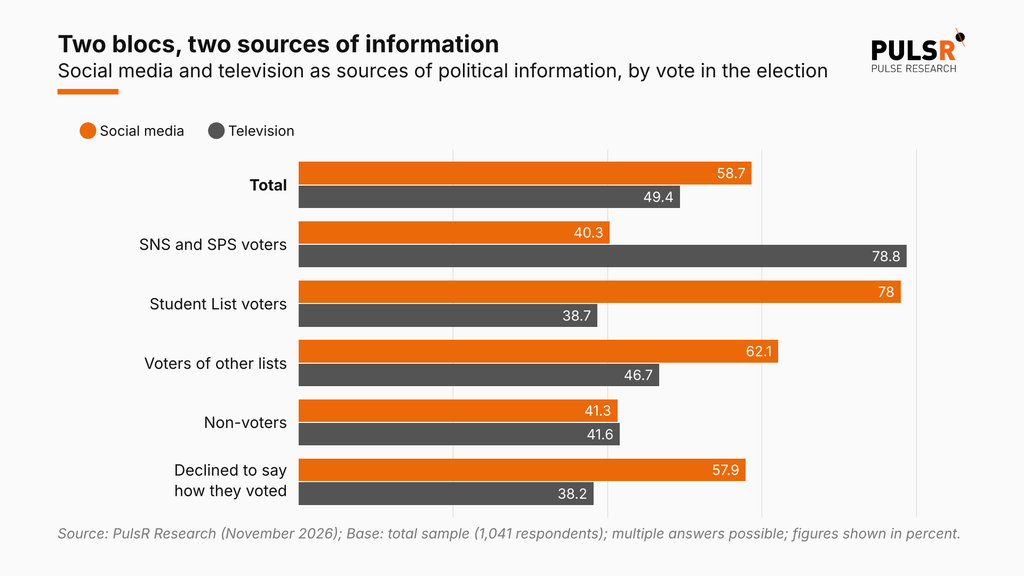
Social media (58.7 percent) have overtaken television (49.4 percent) as the most frequently used source of information on political and social events, according to the post-election survey by PulsR (Pulse Research). Instagram is the most followed single source (36.4 percent), ahead of Facebook (24.7 percent) and RTS (24.6 percent).
Beyond social media and television, citizens often get information through conversations with family and friends (46.5 percent) and from online news portals (40.4 percent), while fewer than one in ten follow newspapers and radio.
Sources of information follow the political divide. SNS and SPS voters get their news mainly from television (78.8 percent), and most often follow RTS (43.7 percent), Pink (42.4 percent) and Informer (37.5 percent). Student List voters get their news from social media (78 percent) and portals (53.3 percent), and most often follow Instagram (52.4 percent), N1 (37.7 percent) and Nova S (25.2 percent).
Interestingly, citizens noticed that the change of government quickly reached newsrooms as well. After the election, almost half of citizens (48.6 percent) noticed that media close to the former government were reporting differently on the Student List. This was said by 70.6 percent of Student List voters and 35.3 percent of SNS and SPS voters.
Social media have overtaken television
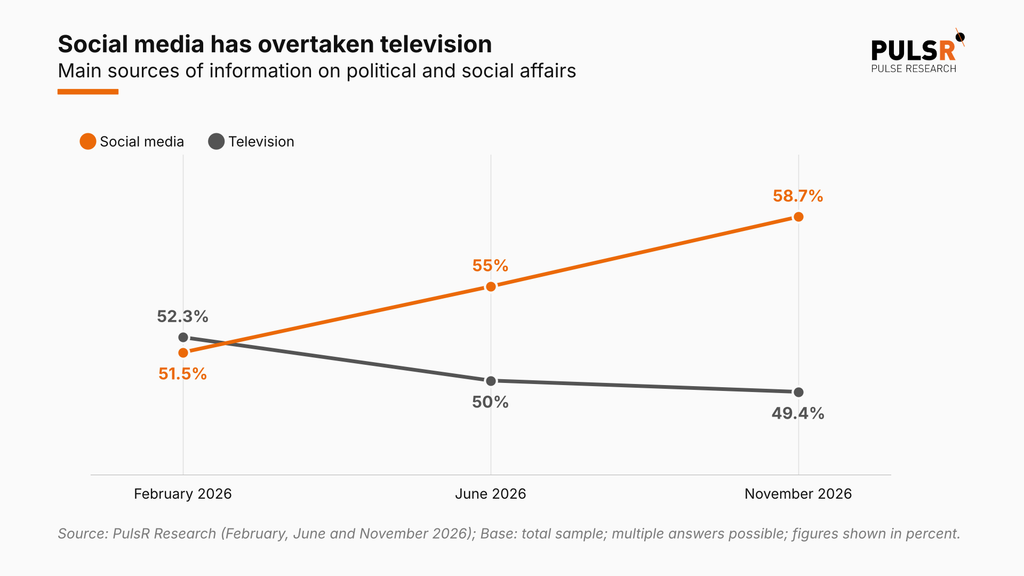
At the start of the year, television held a slight lead: in February it was cited by 52.3 percent of citizens, and social media by 51.5 percent. In June, social media overtook television for the first time (55 to 50 percent), and by November the lead had grown to almost ten percentage points.
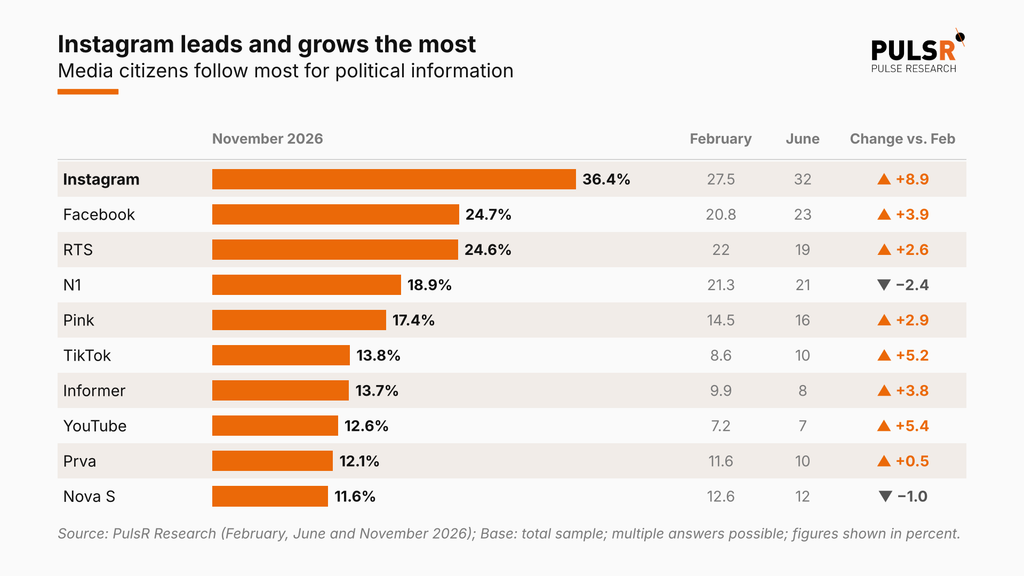
Asked which specific media and networks they follow most, citizens most often name Instagram. In November it was cited by 36.4 percent, compared with 27.5 percent in February and 32 percent in June. Next come Facebook (24.7 percent) and RTS (24.6 percent), which are almost level in November.
Serbia’s media landscape is therefore changing fast. Most citizens now follow politics on their phones, while television remains the main source above all for voters of the former government and for older citizens.
The survey was conducted by PulsR (Pulse Research) from 28 October to 4 November 2026, by telephone interviews (CATI), on a representative sample of 1,041 adult citizens of Serbia, excluding Kosovo; the margin of error is ±3.1 percent. Data for earlier months come from PulsR surveys conducted with the same method: from 21 February to 8 March 2026 (N=2,014, ±2.24 percent) and from 6 to 17 June 2026 (N=1,510, ±3.1 percent).