
If a referendum on joining the European Union were held next week, 44.8 percent of citizens would vote “against” and 34.9 percent “for”, according to the post-election survey by PulsR (Pulse Research). Three quarters of citizens (75.1 percent) believe Serbia best protects its interests by cooperating with everyone, and 77.8 percent reject sanctions on Russia.
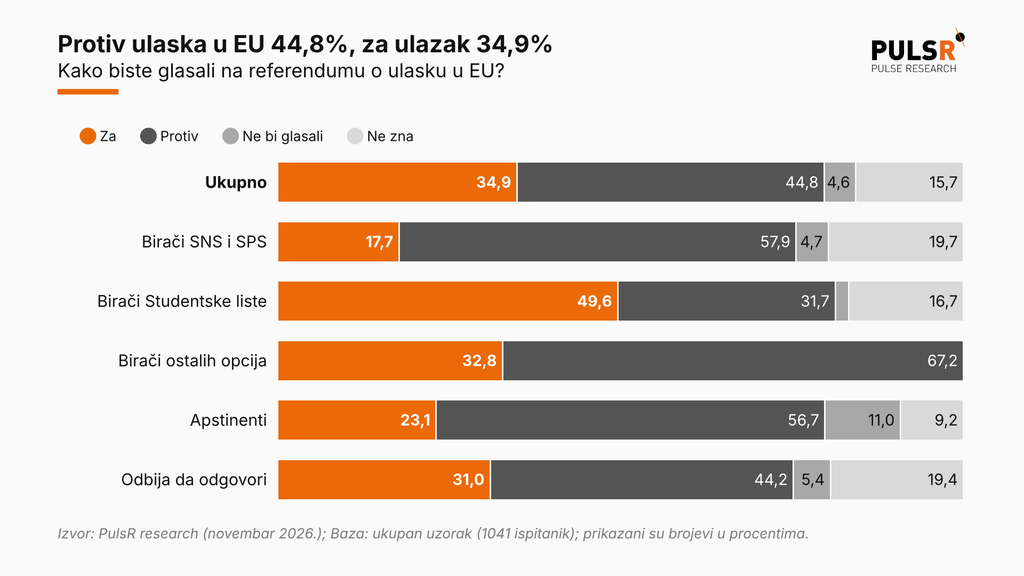
17 percent of citizens have no opinion, and 4.4 percent would not vote in such a referendum. Only among Student List voters are there more people “for” than “against” (49.6 to 31.7 percent). SNS and SPS voters (57.9 percent), non-voters (56.7 percent) and voters of other parties (67.2 percent) are against.
Citizens do not expect major foreign policy changes from the new government either. 37.1 percent believe the change of government will speed up Serbia’s path to the EU, a majority (51.9 percent) do not expect the new government to recognise Kosovo’s independence, and 51.5 percent do not expect sanctions on Russia to be introduced. Only 7.1 percent of citizens think sanctions should be introduced, and Student List voters are also against them (70 percent).
Support for the EU is falling
Support for joining the EU shifted throughout the year. In February, supporters and opponents were level (41.9 to 41 percent), and in June support peaked at 51 percent. In September it returned to a fifty-fifty split (42.5 to 40.5 percent), and in November, for the first time this year, opponents had a clear lead. This clearly shows that Serbian public opinion on EU accession reacts instantly to the ongoing exchange of rhetoric between Belgrade and Brussels.
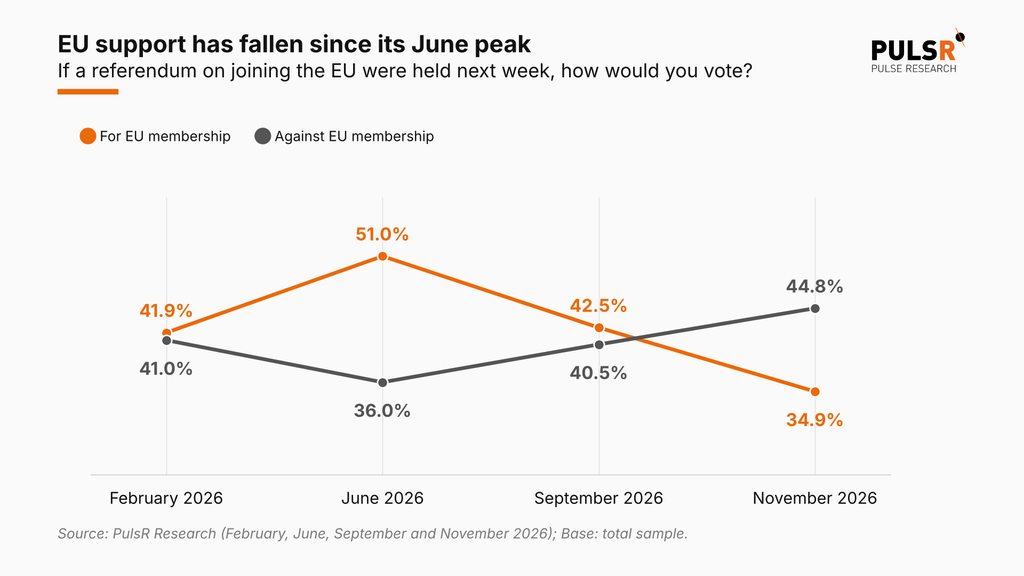
The decline is visible in both of the largest voter blocs. Among Student List voters, support fell from 60.2 to 49.6 percent between September and November, and among SNS and SPS voters from 36.8 to 17.7 percent.
At the same time, the policy of “cooperation with everyone” grew stronger. It was chosen as the best way to protect national interests by 57.5 percent of citizens in February, 59 percent in June and 59.5 percent in September, and by as many as 75.1 percent in November. Close cooperation with the EU fell from 15.5 percent in February to 6.4 percent in November, and is now level with close cooperation with Russia (7.6 percent).
The new government’s mandate is therefore one of reform in domestic policy, the rule of law, the functioning of institutions, their depoliticisation and similar areas, but not a fundamental change in the country’s foreign policy direction, either way. Even among Student List voters, EU membership does not have majority support (49.6 percent), so a sudden foreign policy turn would have no backing even among the new government’s own voters.
The survey was conducted by PulsR (Pulse Research) from 28 October to 4 November 2026, by telephone interviews (CATI), on a representative sample of 1,041 adult citizens of Serbia, excluding Kosovo; the margin of error is ±3.1 percent. Data for earlier months come from PulsR surveys conducted with the same method: from 21 February to 8 March 2026 (N=2,014, ±2.24 percent), from 6 to 17 June 2026 (N=1,510, ±3.1 percent) and from 5 to 20 September 2026 (N=2,022, ±2.22 percent).