
More than half of Serbian citizens (52.2 percent) believe a referendum should be held on continuing the negotiations on joining the European Union, while 30.8 percent are against. Unlike the question of membership itself, which splits the country in half, the idea of letting citizens decide on the negotiations is the most common answer in every group, regardless of age, region, sources of information or party preference, according to the latest survey by PulsR (Pulse Research).
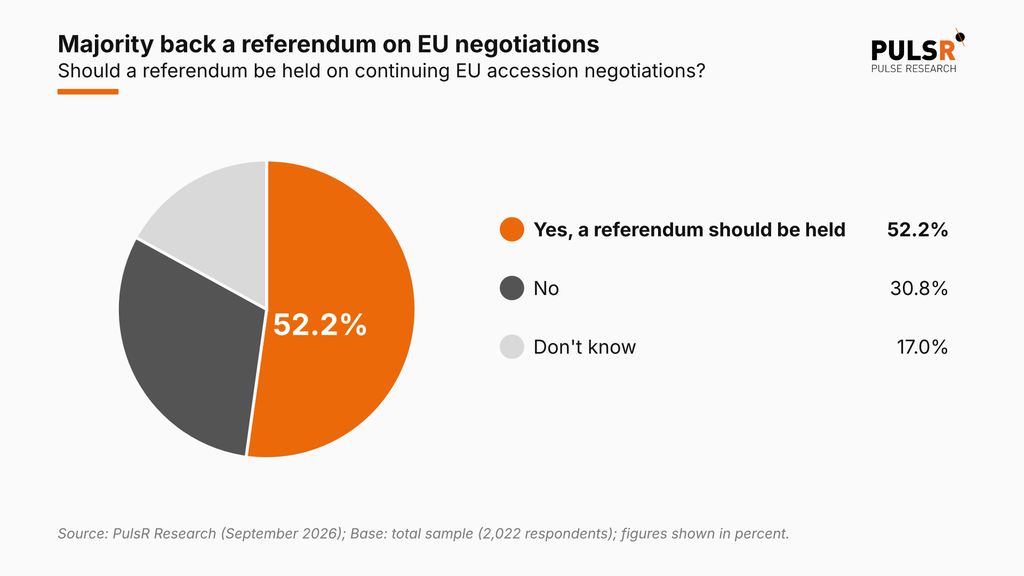
A further 17 percent of citizens have no opinion. The survey measures support for holding a referendum, not how citizens would vote in it. The referendum is most popular among younger citizens: 60.3 percent of those aged 18 to 29 and 58.5 percent of those aged 30 to 39 are in favour. Support is also above average among those who follow only media critical of the government (60.3 percent). Those aged 40 to 49 (38.8 percent) and residents of Vojvodina (35.3 percent) are more often against.
Citizens with only primary education (32.6 percent) and those who do not follow the media (32.4 percent) are the most likely to have no opinion, but even among them “yes” is more common than “no”.
A rare point of agreement
On this question, the difference between the main political groups is small. The referendum is supported by 48.5 percent of SNS and SPS voters and 59.5 percent of Student List voters, while about a third of each group is against (30.2 and 31.5 percent). On the question of EU membership itself, the gap between these two camps is twice as large: 36.8 percent of SNS and SPS voters and 60.2 percent of Student List voters are in favour of joining.
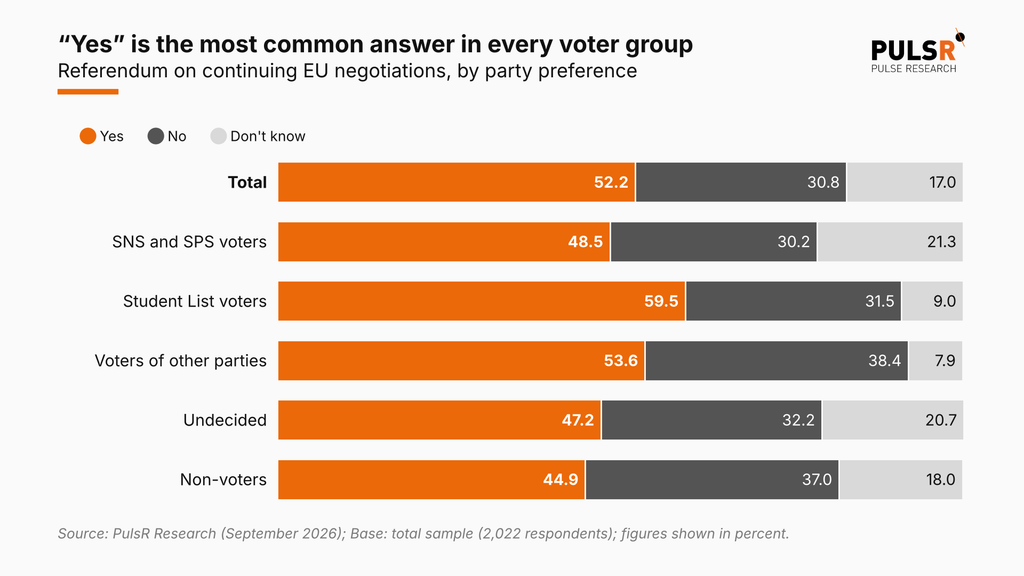
Even those who do not know whom they would vote for, or would not vote at all, support a referendum on continuing the EU negotiations: undecided voters (47.2 percent) and non-voters (44.9 percent).
Serbian citizens are therefore divided over whether they want to join the European Union, but a majority believe they should decide for themselves whether to continue on that path. At a time when almost every question about Europe follows party lines, a referendum on the negotiations is a rare issue on which voters of different parties do not disagree.
The survey was conducted by PulsR (Pulse Research) from 5 to 20 September 2026, by telephone interviews (CATI), on a representative sample of 2,022 adult citizens of Serbia, excluding Kosovo; the margin of error is ±2.22 percent.