
Most Serbian citizens do not want to pick a side. Almost six in ten (59.5 percent) believe the country best protects its interests by cooperating with everyone, while close cooperation with the European Union and with Russia have almost equal support. When it comes to EU membership itself, Serbia is divided into two almost equal halves, according to the latest survey by PulsR (Pulse Research).
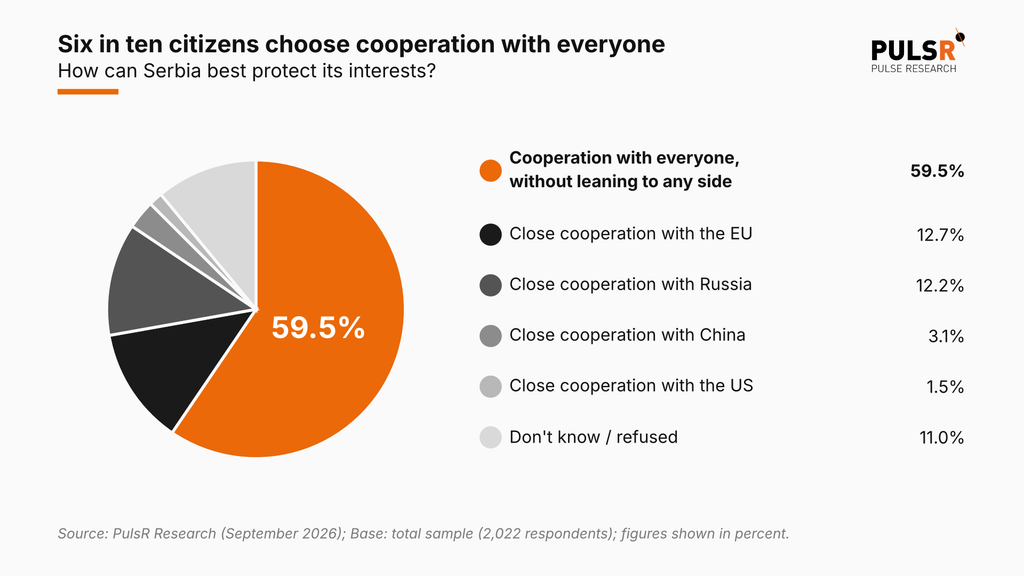
Close cooperation with the European Union is chosen by 12.7 percent of citizens, and close cooperation with Russia by 12.2 percent. China and the United States lag far behind, and 11 percent of citizens have no opinion or do not want to answer.
“Cooperation with everyone” is the most common answer regardless of gender, age, region, education, sources of information and party preference. The only exception are citizens who follow only media critical of the government: among them, close cooperation with the EU (42.5 percent) is level with cooperation with everyone (41.8 percent). Student List voters (31.3 percent) and the highly educated (21.6 percent) are also more oriented towards Europe.
On the other side, cooperation with Russia is more often chosen by non-voters (23 percent), residents of Šumadija (20.5 percent) and the youngest citizens, aged 18 to 29 (19.2 percent). Among SNS and SPS voters, 15.4 percent choose Russia and only 3.4 percent the European Union.
A referendum within the margin of error
If a referendum on joining the European Union were held next week, 42.5 percent of citizens would vote for and 40.5 percent against. The difference is within the margin of error, and one in six citizens (15.5 percent) still have no opinion.
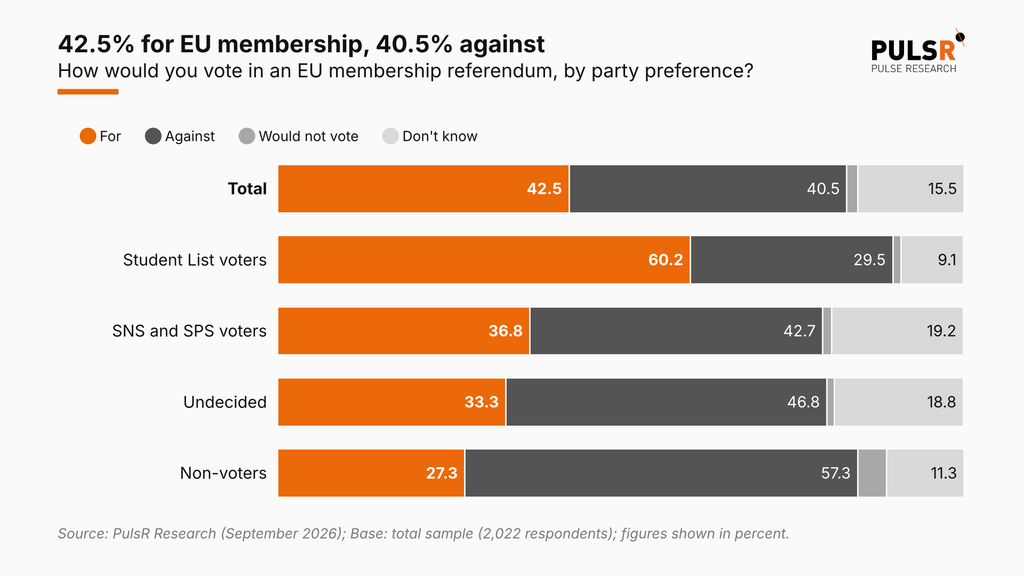
There is a majority for joining in only a few groups: among Student List voters (60.2 percent), the highly educated (52.1 percent) and citizens aged 30 to 39 (50.5 percent). Voters of the ruling coalition are not united: 42.7 percent are against, 36.8 percent are for, and one in five have no opinion. The most firmly opposed are non-voters (57.3 percent), voters of other parties (55.4 percent) and residents of Western Serbia (53.2 percent).
The same divide appears when citizens assess the consequences of membership: 39.9 percent expect more benefits, and 38.8 percent more harm.
Serbian citizens therefore do not want to choose between East and West, but when asked about Europe, they split almost in half. The outcome of a possible referendum could thus be decided by the undecided, who are most numerous among citizens with only primary education (28.8 percent) and those over 65 (24.4 percent).
The survey was conducted by PulsR (Pulse Research) from 5 to 20 September 2026, by telephone interviews (CATI), on a representative sample of 2,022 adult citizens of Serbia, excluding Kosovo; the margin of error is ±2.22 percent.