
The fight against corruption (26.6 percent) and judicial reform (19.4 percent) are the most frequently cited priorities for the new government, according to the post-election survey by PulsR (Pulse Research). Almost half of citizens (48.4 percent) are ready to wait about a year for the first results, and more than half (56.4 percent) expect the new government to do better than the previous one.
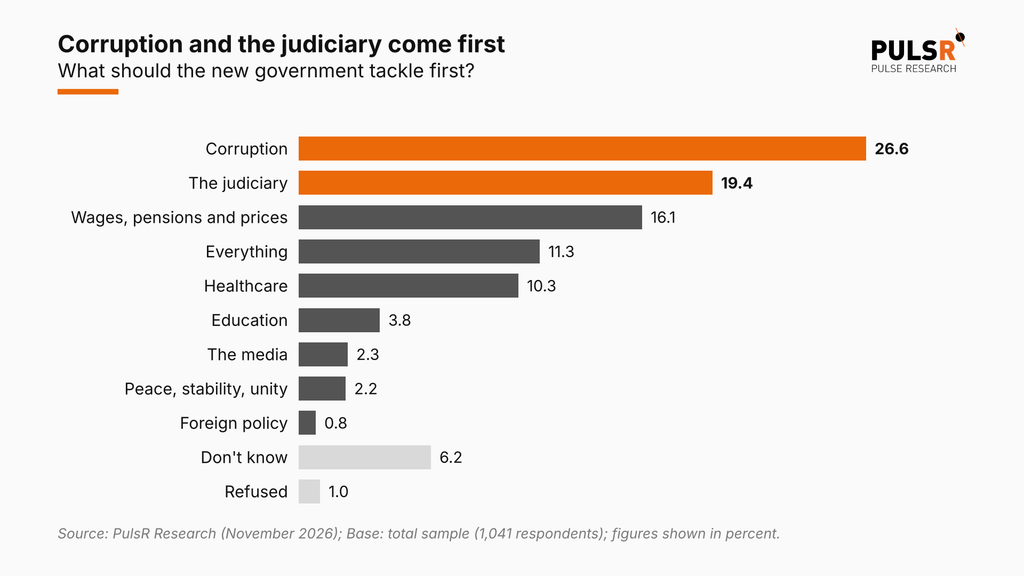
After corruption and the judiciary come wages, pensions and prices (16.1 percent) and healthcare (10.3 percent), while 11.3 percent say the government should tackle all problems at once. Education, the media and foreign policy are rarely named as the first task, but they are still seen as priorities for the newly elected government.
Priorities differ across voter groups. Student List voters most often name corruption (41.3 percent) and the judiciary (28 percent) as priorities. SNS and SPS voters put wages, pensions and prices first (29.4 percent), and only 9.8 percent of them mention corruption. Among non-voters, incomes and prices also come first (21.3 percent).
Corruption was the top demand even before the election. It was named as one of Serbia’s biggest problems by 17.1 percent of citizens in February 2026, 22 percent in June 2026 and 18.3 percent in September this year. As early as February, when citizens were asked what the government’s priority should be after a possible change of power, 46.1 percent named the fight against corruption, followed by economic measures (27.3 percent) and lustration (23.7 percent).
For the first 100 days of Serbia’s new government, citizens expect corruption proceedings (19.6 percent), measures to improve living standards (18.1 percent), preserving peace and keeping institutions working (16.9 percent), and appointing people of integrity to key positions (16.2 percent).
Student List voters are the most patient
Almost half of citizens are ready to wait about a year for the new government’s first results (48.4 percent), 35.8 percent give it up to six months, and 9.5 percent believe this government will never deliver results.
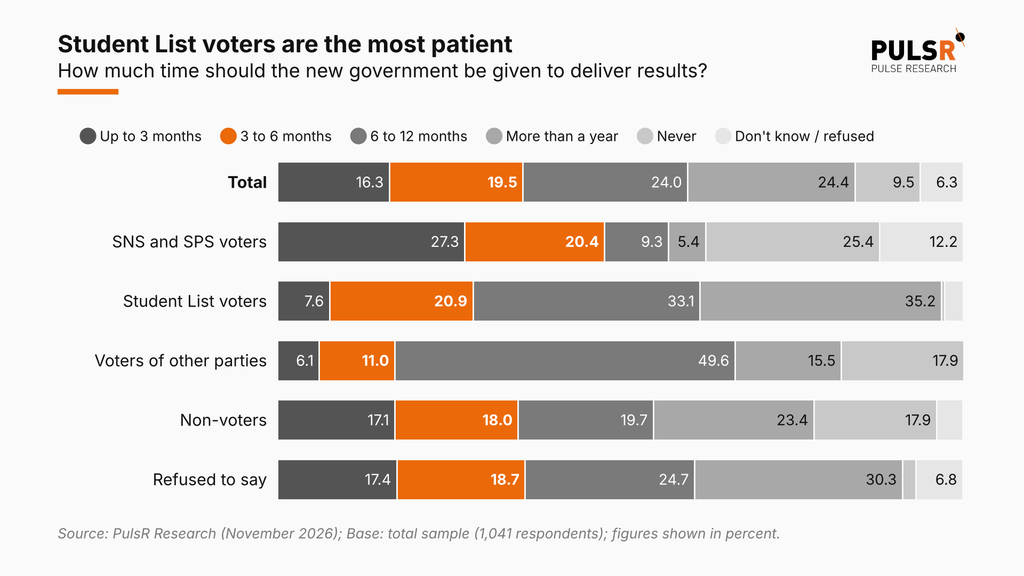
Student List voters are the most patient: 68.3 percent give the government a year or longer. SNS and SPS voters show their doubts about the new government’s chances of success by being willing to wait no more than six months for results (47.7 percent up to six months). This is confirmed by the fact that one in four of them (25.4 percent) believe there will never be any results.
Expectations are positive. More than half of citizens (56.4 percent) think the new government will do better than the previous one, while 21.7 percent, mostly SNS and SPS voters, think it will do worse. When it comes to their own standard of living, citizens are more cautious: 23 percent expect their household’s financial situation to improve over the next year, 45.8 percent expect it to stay the same, and 16.7 percent expect it to get worse.
The new government is therefore getting broad credit of trust, but with an expiry date. Student List voters will judge the government’s success mainly by how it deals with corruption, and they are ready to wait for results. Voters of the former government and part of the wider public will judge the government’s economic measures (wages, pensions and prices) and expect results much sooner.
The survey was conducted by PulsR (Pulse Research) from 28 October to 4 November 2026, by telephone interviews (CATI), on a representative sample of 1,041 adult citizens of Serbia, excluding Kosovo (margin of error ±3.1 percent). Data for earlier months come from PulsR surveys conducted with the same method: from 21 February to 8 March 2026 (N=2,014, ±2.24 percent), from 6 to 17 June 2026 (N=1,510, ±3.1 percent) and from 5 to 20 September 2026 (N=2,022, ±2.22 percent).